Gravesite Holds A Forgotten Story Of Melbourne’s First Mafia Crimes
By Lily Tuck
July, 2025
This story contains depictions of violent themes*
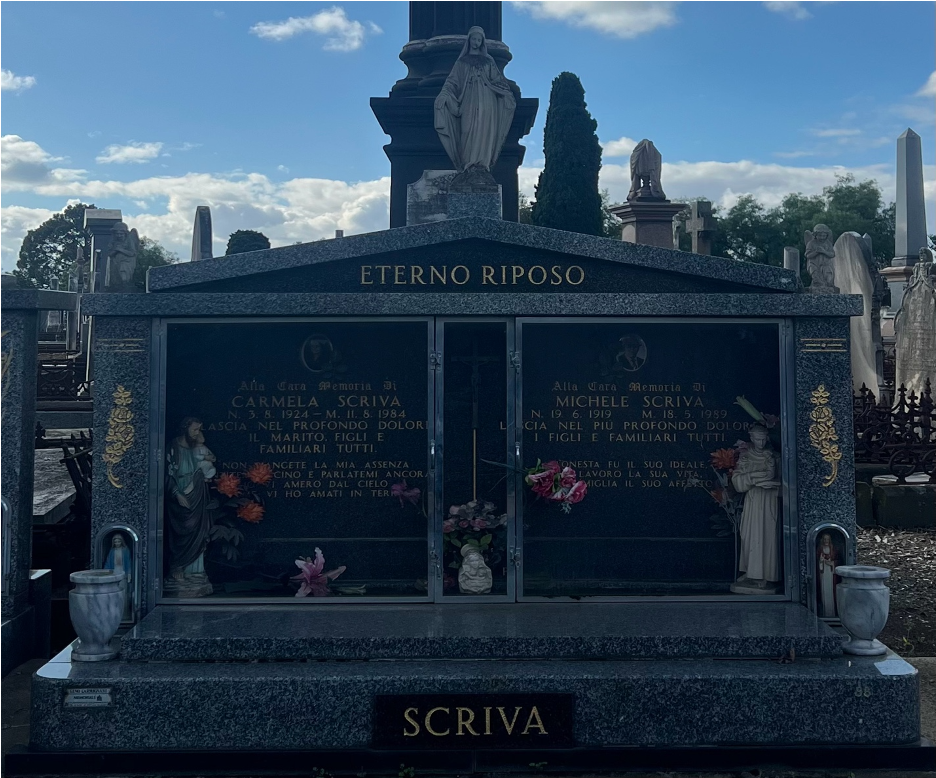
Image Michele Scriva's grave (Lily Tuck)
Through the winding avenues within Melbourne’s General Cemetery one of the first members of Melbourne’s ‘Ndrangheta is buried.
Michele Scriva’s final resting place adorned with gold, encased with glass and laid with flowers that will never die, is situated amongst an endless row of uniform headstones.
The site where Michele rest is unassuming, but Scriva’s life was nothing of the sort, plagued with infamy for his role in two murders, and involvement in the ‘Ndrangheta.
The ‘Ndrangheta being the Calabrian branch of mafia, linked to the black hand movement of extortion seen in Australia after the 1920’s.
The wall of Omertà is enshrined in the ideology of the ‘Ndrangheta, translating to a wall of silence, often interpreted as a code of silence within southern Italian communities.
It is unsurprising that information of the ‘Ndrangheta was difficult for Australian authorities to uncover.
The death of ‘Fat Joe’ Versace by the infliction of 91 stab wounds, is often considered Melbourne’s first Mafia killing, and Scriva ‘witnessed’ it.
October 7th,1945, Joe Versace, Domenico Pezzimenti, Domenico Demarte and Michele Scriva attend a Fitzroy townhouse.
According to the statements in public records, Pezzimenti said a disagreement broke out between him and Versace surrounding comments he’d made about a woman.
Pezzimenti recalled in his statement.
“He said [Versace] ‘I am going to stab and kill you’.”
The record shows Pezzimenti told police he then “"stabbed Joe Versace with the pocket knife a lot of times, I don't know how many,".
Scriva denied he was there in his original statement, but when police searched his home, they found knives, a bloodied shirt and freshly washed trousers.
He later said he waited in the hallway whilst the fight broke out.
Joe Versace was found disfigured and disembowelled; with the contents of his stomach spilling out.
Pezzimenti and Demarte turned themselves in, resulting in theirs and Scriva’s arrest. Scriva and Demartes case was dismissed by a judge due to a lack of evidence.
Pezzimenti testified in court he stabbed Versace 8 -or-9 times; the remaining stab wounds were never accounted for as Pezzimenti was found not guilty by a jury on the ground of self-defence.
Versace’s murder of 1945 would not be the last time Scriva would be arrested on a murder charge.
The culture in Australia in time of ‘Ndrangheta forming; was for Italians “a time where you were exposed to victimisation from your own people among whom were members of criminal organisations looking to make a profit” Anna Sergi, Professor of Criminology at The University of Essex, said.
Michele Scriva and Carmela Italiano married in 1942. The daughter of Domenico Italiano, often referred to as Melbourne’s godfather, ‘The Pope’.
On September 23rd, 1950, Michele and Carmela’s three-year-old daughter Therese was hit by a car outside their home.
“The scene of the accident had become involved in a quarrel ‘with a number of Italians’.” Reported in the following days edition of The Sun.
Scriva was arrested and tried for the murder of Veteran Frederick John Duffy, a passenger in the car which hit Therese.
Therese was taken to the children’s hospital and assessed for minor head wounds, as reported at the time.
Scriva’s trial was covered nationally in the press; his alibi that he was wearing a blue suit on the day was heavily contested in court, it had previously been reported that the man who killed Duffy was wearing a maroon jumper.
Carmela testified in court as a witness; she said “I rushed over to where she was and picked her up. She was like dead; she could move nothing.”
She also pledged that her husband had never owned a maroon jumper when addressing The Crown, as reported by The Sun.
The case received further publicity when The Sun was found guilty by the Supreme Court in December of that year for contempt by publishing images of Scriva.
Scriva would go on to be found guilty, sentenced to death at Coburg’s Pentridge prison.
However, through appeal his sentence was changed to 20-year imprisonment.
It is assumed he was released in 1960, but due to water damage on records found in Pentridge prison, it is unclear.
Scriva lays buried next to the woman who testified his innocence in a murder trial, the incidents of 1950 untold in their final resting place.
The text on his headstone; translated reads, ‘honesty was his ideal work, his life, his family, his affection’. A stark contrast to the events that live within his history.
The wall of Omertà continues on at Scriva’s final resting place, a code of silence over the events that transpired during his life.
The sentiment of the ‘Ndrangheta remains within his grave.
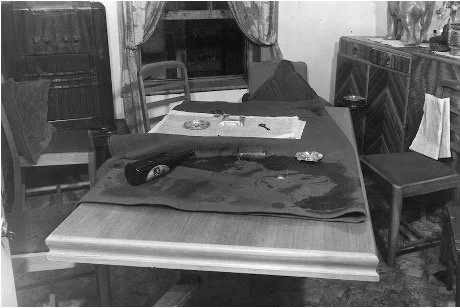
Crime Scene image (Public Records Office Victoria)
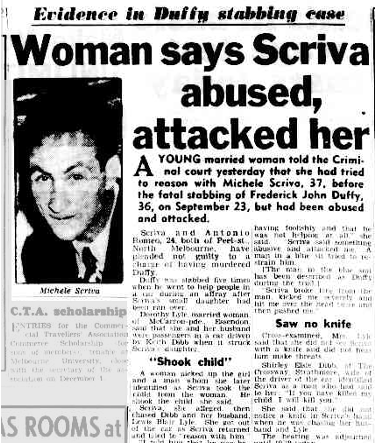
The image which resulted in the guilty finding of The Sun by the Supreme Court (State Library of Victoria)
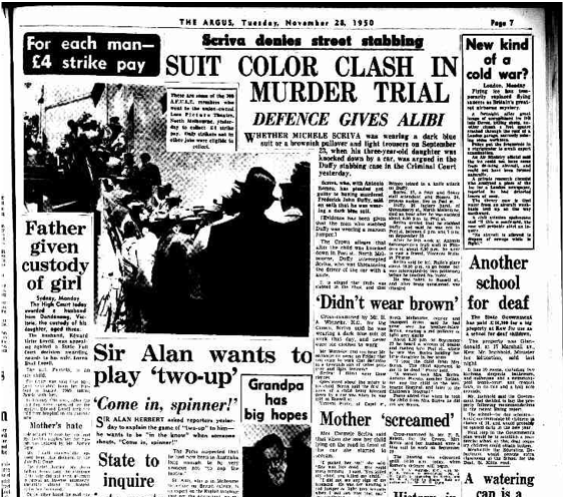
The front page of The Angus, Melbourne November 28, 1950 (The State Library of Victoria)